
Snapshot
A viral video narrated by respected journalist Najwa Shihab, “Peringatan Darurat” (Emergency Warning), became the catalyst for mass protests in Indonesia against proposed changes to the Regional Head Election Law (UU Pilkada). This study examines how source credibility, moral emotions, and social engagement transformed online outrage into offline action in a collectivist Southeast Asian context.
Background
Digital platforms have redefined civic activism, with movements like #MeToo and the Arab Spring showing the potential of viral content to inspire political action. While Western contexts are well-studied, there’s limited research on how mobilization works in collectivist societies like Indonesia, where trust, moral duty, and community solidarity play pivotal roles. In 2024, the “Peringatan Darurat” video—critical of perceived undemocratic legal changes—gained 1.9 million views in 48 hours, sparking both social media campaigns and street demonstrations.
Aim
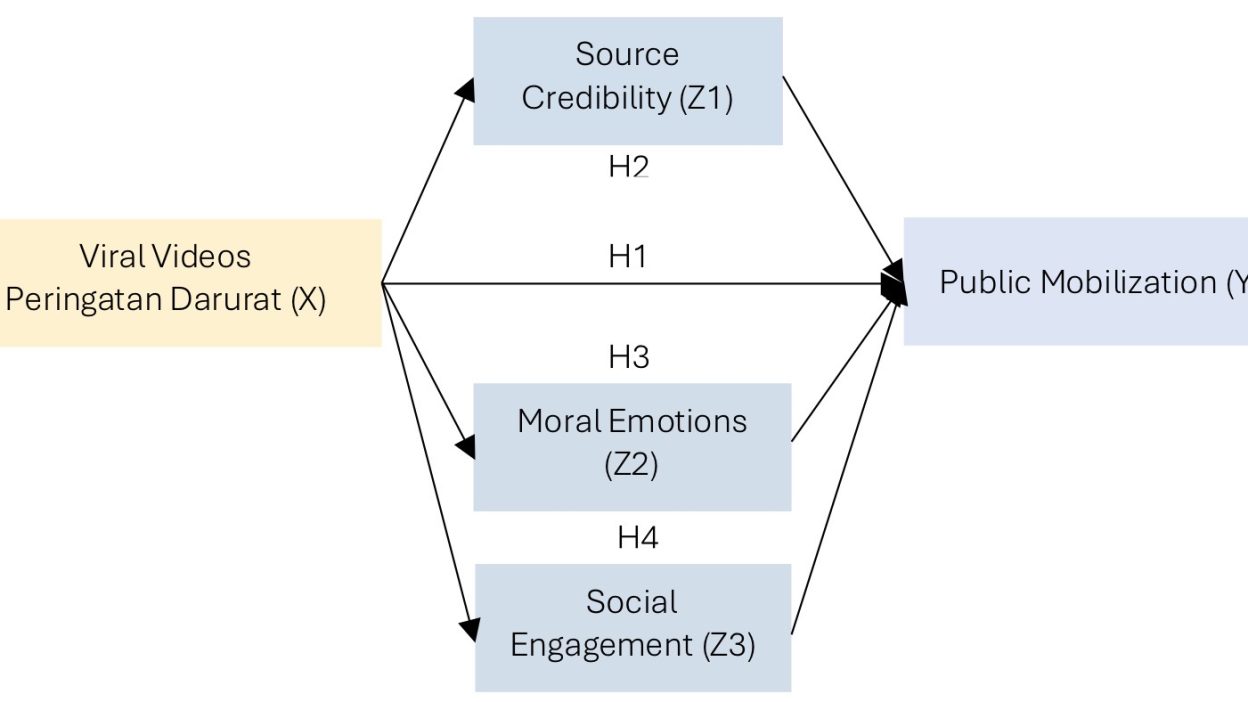
The study investigates how viral content drives public mobilization in Indonesia, focusing on three mediators:
- Source Credibility – The trustworthiness and expertise of the messenger.
- Moral Emotions – Outrage, empathy, and guilt triggered by the message.
- Social Engagement – Online participation through sharing, commenting, and hashtag activism.
Method
- Design: Quantitative survey research.
- Sample: 384 Indonesian social media users aged 17–65 who viewed the “Peringatan Darurat” video.
- Sampling: Non-probability purposive sampling.
- Analysis: Generalized Structured Component Analysis (GSCA).
- Frameworks Used: Viral Content Diffusion Theory, Digital Mobilization Theory, Moral Foundations Theory, Source Credibility Framework, and Social Engagement Framework.
Findings
- Direct Effect: Viral video exposure significantly increased public mobilization.
- Mediation Effects:
- Social Engagement – strongest pathway (indirect effect = 0.275), showing that digital interactions acted as a bridge to offline action.
- Moral Emotions – second strongest (0.097), with moral outrage and empathy fueling activism.
- Source Credibility – also significant (0.076), with Najwa Shihab’s reputation amplifying trust in the message.
- Combined, these mediators explained 69.2% of the variance in public mobilization.
Implications
- For Activists: Collaborating with trusted figures and creating emotionally resonant narratives can maximize mobilization.
- For Policymakers & NGOs: Strategic digital storytelling can foster democratic participation, especially when aligned with cultural values.
- For Media Professionals: Beyond informing, content must inspire moral and collective responsibility to translate awareness into action.
Conclusion
The “Peringatan Darurat” case shows that viral content in Indonesia can drive substantial public mobilization when supported by credible messengers, moral appeals, and participatory digital culture. In collectivist societies, activism is less about individual expression and more about shared political identity—making social engagement the critical link between online outrage and real-world change.
https://doi.org/10.36923/jicc.v25i3.1115
Authors
Faculty of Social and Political Sciences, Universitas Diponegoro, Semarang, Indonesia
https://orcid.org/0009-0008-8871-2497
Faculty of Social and Political Sciences, Universitas Diponegoro, Semarang, Indonesia
https://orcid.org/0000-0002-6897-9767
Faculty of Social and Political Sciences, Universitas Diponegoro, Semarang, Indonesia
https://orcid.org/0009-0008-2987-8438
Faculty of Social and Political Sciences, Universitas Diponegoro, Semarang, Indonesia
https://orcid.org/0000-0002-3072-9893
Department of Communication Science, Universitas Semarang, Indonesia


