
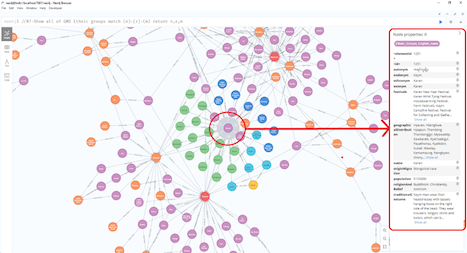
Snapshot
A cutting-edge project introduces a semantic knowledge graph and accompanying web application to represent and explore the cultural richness of 375 ethnic groups in the Greater Mekong region—spanning Thailand, Laos, Myanmar, Cambodia, Vietnam, and China—using advanced semantic web technologies and community‑informed data.
Background
Traditional knowledge organization systems (KOS) often fall short in capturing the dynamic, multifaceted nature of ethnographic identities—especially across language, religion, cultural practices, geography, and migration histories. The study responds to this shortfall by blending semantic technologies with culturally grounded inputs.
Aim
The research aims to design, develop, and evaluate a semantic knowledge graph with a user-friendly web interface that ethically and effectively portrays the ethnographic diversity of the region, integrating community‑sourced data to preserve cultural authenticity.
Method
- Data Structuring & Modeling: Utilized structured data transformation and entity‑relation modeling using Neo4j for knowledge graph construction.
- Interface Development: Employed React.js and D3.js for interactive visualization.
- Collaborative Sourcing: Engaged over 20 regional scholars to ensure cultural accuracy.
- Evaluation Approach: Conducted extrinsic and domain‑specific validation involving 24 usability experts and 17 ethnographers, assessing usability, data completeness, and cultural alignment.
Findings
- The semantic knowledge graph outperformed conventional databases by over 25% in usability, interpretability, and task efficiency among expert evaluators.
- It offers multilingual access, tracks temporal migration patterns, and supports contextualized cultural identities.
Implications
This research demonstrates how ethically designed, semantically enriched knowledge infrastructures can elevate the representation and accessibility of marginalized cultural knowledge. Its model has wide applicability across digital humanities, education, and policy making, offering a replicable framework for creating equitable and culturally sensitive knowledge systems globally.
Conclusion
Semantic knowledge graphs, when thoughtfully crafted and community‑collaborative, significantly enhance the usability and representational depth of ethnographic information. While the framework is powerful, it currently faces limitations—such as reliance on manual data curation and gaps in capturing hybrid cultural practices. The authors advocate for future efforts focused on automation for scalability and ongoing community engagement to expand and refine the system.
https://doi.org/10.36923/jicc.v25i3.1161
Authors
Faculty of Humanities And Social Sciences, Khon Kaen University, Thailand
https://orcid.org/0000-0001-5546-8485
Faculty of Humanities And Social Sciences, Khon Kaen University, Thailand
https://orcid.org/0000-0002-8848-2168
School of Government, Beijing Normal Universit, Beijing, China
https://orcid.org/0000-0003-1520-1297
Wee Kim Wee School of Communication & Information, Nanyang Technological University, Singapore


