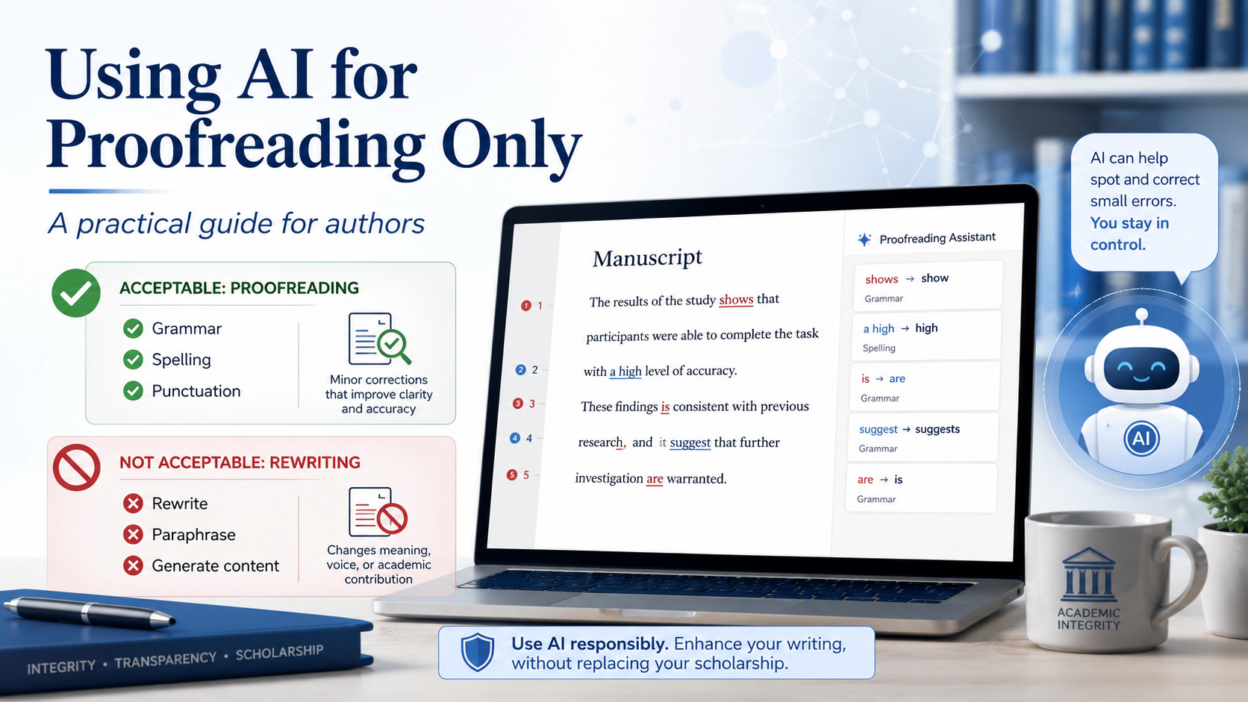
Artificial intelligence tools such as ChatGPT, Grammarly, and other language-support systems can be helpful for authors, especially when English is not their first language. These tools can assist with grammar, spelling, punctuation, sentence clarity, and minor language corrections. However, authors must clearly understand the difference between proofreading and rewriting.
Using AI for proofreading is generally acceptable when it is limited, transparent, and does not change the scholarly content of the manuscript. However, using AI to generate, rewrite, paraphrase, expand, or develop academic content may create serious ethical concerns. It may also result in a high AI-detection score, even when the similarity score is low.
This guide explains how authors can use AI responsibly for proofreading only.
1. What Does “AI for Proofreading Only” Mean?
Using AI for proofreading means using the tool to correct language errors without changing the author’s original ideas, arguments, research design, results, interpretation, or academic contribution.
Proofreading may include:
- correcting spelling mistakes;
- fixing grammar errors;
- improving punctuation;
- correcting tense and subject–verb agreement;
- correcting article use, such as “a,” “an,” and “the”;
- identifying unclear sentences;
- suggesting minor clarity improvements without changing meaning.
Proofreading does not mean asking AI to rewrite the manuscript. It does not mean asking AI to make the paper more academic, more professional, more advanced, or more publishable. Those requests usually lead to substantial rewriting and may change the author’s original voice and scholarly contribution.
2. What Authors Should Not Ask AI to Do
Authors should avoid using prompts such as:
“Rewrite this paragraph in academic language.”
“Improve this section.”
“Make this manuscript suitable for journal publication.”
“Paraphrase this literature review.”
“Expand the discussion.”
“Write a stronger introduction.”
“Create a better conclusion.”
“Add more recent references.”
“Generate the theoretical framework.”
“Improve the methodology.”
These instructions go beyond proofreading. They may cause the AI tool to produce new content, restructure arguments, change meanings, or generate polished text that no longer reflects the author’s original writing. This creates a risk that the manuscript may be considered AI-generated rather than author-written.
3. What Authors May Ask AI to Do
Authors may use AI in a limited and controlled way. The safest approach is to ask AI to identify and explain corrections, not to rewrite the whole text.
A suitable proofreading prompt is:
“Please proofread the following text only for grammar, spelling, punctuation, tense, article use, subject–verb agreement, and minor clarity. Do not rewrite the sentences. Do not paraphrase. Do not change the structure, meaning, argument, citations, references, terminology, results, or academic content. Show the corrections in a table with three columns: original text, suggested correction, and reason for correction. If no correction is needed, write ‘No change.’”
This type of prompt keeps the AI tool limited to proofreading. It also allows the author to review each suggested correction before accepting it.
4. Best Practice: Use AI as a Checker, Not as a Writer
Authors should treat AI like a proofreading assistant, not a co-author and not a ghostwriter. The author must remain responsible for every sentence in the manuscript.
A good process is:
First, the author writes the full manuscript independently.
Second, the author saves the original version before using any AI tool.
Third, the author submits only small sections to AI, such as one paragraph at a time.
Fourth, the author asks AI only to identify grammar and punctuation corrections.
Fifth, the author reviews each correction manually.
Sixth, the author applies only necessary corrections using Track Changes.
Seventh, the author keeps the original version, AI correction table, and final revised version as evidence.
This process helps show that AI was used only for language support and not for generating the manuscript.
5. Why Authors Should Avoid Pasting the Whole Manuscript for Rewriting
When authors paste the whole manuscript into AI and ask it to “improve,” “rewrite,” or “make it academic,” the tool may change a large amount of text. Even if the research idea belongs to the author, the final wording may become heavily AI-generated.
This can create several problems:
- the manuscript may lose the author’s original voice;
- the meaning of sentences may change;
- citations may no longer accurately support the claims;
- the AI may introduce unsupported statements;
- the final text may appear artificially polished;
- the AI-detection score may become very high;
- the author may not be able to prove what was originally written.
For this reason, authors should never use AI as a rewriting tool for the full manuscript.
6. The Difference Between Proofreading and Rewriting
The following table shows the difference between acceptable proofreading and problematic rewriting.
| Acceptable proofreading | Problematic rewriting |
|---|---|
| Correcting grammar errors | Rewriting full paragraphs |
| Fixing punctuation | Changing the argument |
| Correcting spelling mistakes | Adding new ideas |
| Improving minor clarity | Expanding the literature review |
| Correcting tense | Creating new interpretations |
| Correcting article use | Generating citations or references |
| Suggesting small wording corrections | Writing the discussion or conclusion |
| Highlighting unclear sentences | Changing the author’s academic voice |
Authors should stay on the left side of the table. Once AI starts changing the meaning, structure, or content, it is no longer proofreading.
7. Recommended AI Proofreading Prompt for Authors
Authors may use the following prompt whenever they use AI for proofreading:
“Please proofread the text below only for grammar, spelling, punctuation, tense, article use, subject–verb agreement, and minor clarity. Do not rewrite or paraphrase the text. Do not improve the academic style beyond necessary corrections. Do not change the meaning, structure, argument, citations, references, terminology, data, findings, or interpretation. Present your suggestions in a table with: original text, suggested correction, and reason. I will decide which corrections to accept.”
This prompt protects the author because it limits the AI tool to language correction.
8. Examples of Safe AI Use
Original sentence:
“The data was collected through interview and observation and document analysis.”
Acceptable proofreading correction:
“The data were collected through interviews, observations, and document analysis.”
This is acceptable because the correction improves grammar and plurality without changing the meaning.
Original sentence:
“Teachers was using textbook because exam pressure was high.”
Acceptable proofreading correction:
“Teachers were using textbooks because examination pressure was high.”
This is also acceptable because it corrects grammar and wording without adding new content.
9. Examples of Unsafe AI Use
Original sentence:
“Teachers were using textbooks because examination pressure was high.”
Unsafe AI rewrite:
“The findings reveal that systemic assessment-oriented structures in Taiwan’s bilingual education system constrain teachers’ pedagogical agency and limit the implementation of communicative language teaching practices.”
This is not simple proofreading. The AI has introduced new academic language, new interpretation, and a more complex argument. If the author did not originally write this idea, it should not be accepted as a proofreading correction.
10. Authors Must Not Use AI to Generate References
Authors should not ask AI to create citations or references. AI tools may generate references that look real but are inaccurate, incomplete, irrelevant, or entirely fabricated. Authors must personally verify every source, citation, DOI, and reference.
AI should not be used to:
- invent references;
- find support for claims without verification;
- create APA references automatically without checking;
- add citations to statements;
- summarise studies that the author has not read.
Every citation must come from a source that the author has personally checked.
11. Keep Evidence of Original Work
If a journal asks about AI use, authors should be able to provide evidence that the manuscript is their own work. Authors should keep:
- the original draft before AI proofreading;
- the AI proofreading output;
- a tracked-changes version;
- notes showing which corrections were accepted;
- research data and analysis files, where applicable;
- interview transcripts, observation notes, coding sheets, or statistical outputs, depending on the study type.
This evidence helps demonstrate that AI was used only for limited language support.
12. AI Use Must Be Disclosed Transparently
If AI was used, authors should disclose it according to the journal’s policy. A suitable disclosure statement may be:
“The authors used AI-assisted tools only for limited proofreading, including grammar, spelling, punctuation, tense, and minor language clarity checks. The tools were not used to generate research content, develop arguments, conduct analysis, interpret findings, create citations, or write substantive sections of the manuscript. The authors reviewed and approved all corrections and take full responsibility for the accuracy, originality, and integrity of the work.”
This statement is appropriate only when AI was genuinely used for proofreading only. If AI was used for drafting, rewriting, summarising literature, developing arguments, or preparing sections of the manuscript, the author must disclose that more clearly.
13. AI Detection Scores Should Be Interpreted Carefully
AI-detection tools can help editors identify possible AI-generated writing, but they are not perfect. They may produce false positives or false negatives. Therefore, an AI report should not be the only basis for a final decision.
However, a very high AI-detection score may raise legitimate editorial concerns, especially if the author claims that AI was used only for grammar correction. In such cases, the journal may ask the author to provide the original draft, tracked changes, and a detailed explanation of AI use.
14. Final Advice for Authors
AI can be useful for proofreading, but it must be used carefully and ethically. The safest rule is simple:
Use AI to correct errors, not to write the manuscript.
Authors should remain the original creators of the manuscript. AI may support language accuracy, but it must not replace the author’s thinking, analysis, interpretation, or scholarly voice.
Before submitting a manuscript, authors should ask themselves:
Did I write the manuscript myself?
Did AI only correct grammar and punctuation?
Did I avoid AI rewriting or paraphrasing?
Did I verify all references myself?
Did I keep the original version before AI proofreading?
Did I disclose AI use honestly?
If the answer to all these questions is yes, then AI has likely been used responsibly as a proofreading tool only.
Conclusion
Responsible AI use in academic writing depends on transparency, control, and author accountability. Authors may use AI for limited proofreading, but they should not use it to generate, rewrite, paraphrase, expand, or develop scholarly content. The manuscript must remain the author’s own intellectual work.
The best practice is to write first, save the original draft, use AI only for minor language corrections, review every suggestion manually, keep Track Changes, and disclose AI use clearly. This approach protects the author, supports editorial transparency, and maintains the integrity of scholarly publishing.